Global solar projects depend on details that are easy to overlook. A cable may run beneath bright modules, across a hot rooftop, or through a damp conduit. Its insulation, conductor, temperature rating, and documented test results all matter. Buyers comparing China’s Solar Cable manufacturers should look beyond price and product photos. Ask for current technical data, traceable test reports, production quality controls, and clear warranty terms. Verify that claimed certifications match the exact cable model and the destination market’s requirements.
In this guide, we use a clearly identified composite industry perspective rather than attributing an unverified quotation to a real person. Composite solar cable engineer Lin Wei offers this editorial reminder: “A cable’s weakest detail can become a project’s most expensive delay.” That is a practical warning, not a sourced verbatim quotation. Good sourcing takes more than one email. Request samples, inspect markings, and compare datasheets against the project design. Ask how the manufacturer controls material consistency between batches. Small gaps matter. A polished factory profile cannot replace independent evidence, and this guide will note where buyer checks remain necessary. The goal is a useful shortlist, not an effortless endorsement.
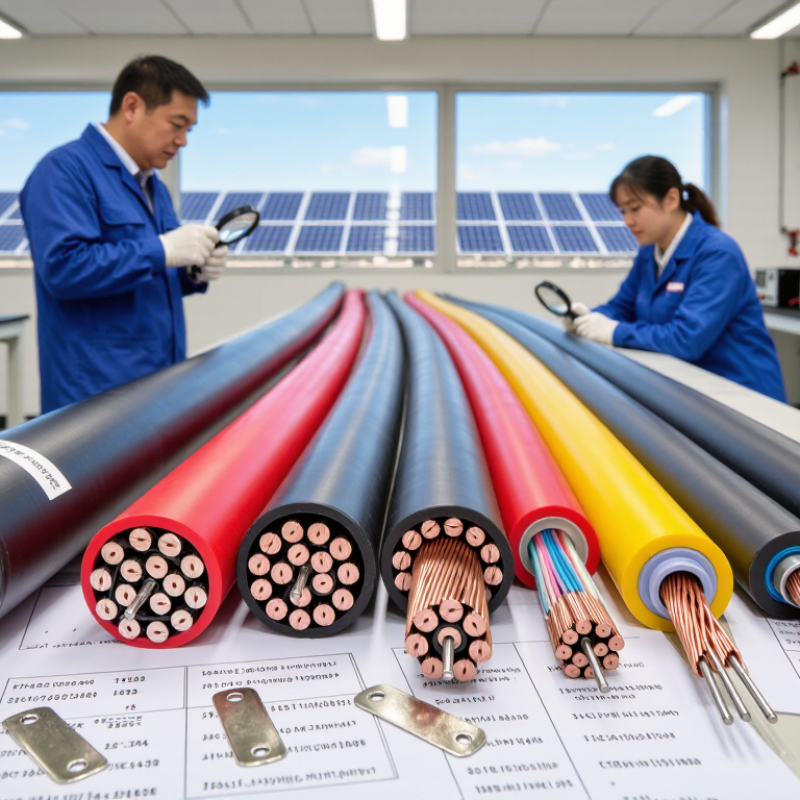
Solar cables carry direct-current power from photovoltaic modules to inverters and protection equipment. Their role is more demanding than ordinary building wiring. They face sunlight, rain, heat, bending, and occasional contact with sharp mounting rails. Proper solar cables usually use tinned copper conductors and durable cross-linked insulation. These materials reduce oxidation and improve service life in outdoor conditions.
Small details matter. Field inspections often find damage near connectors, cable clips, and roof edges. Tight bends can stress insulation and increase electrical risk. Cables should match the system voltage, current, temperature range, and installation method. Voltage drop also deserves attention, especially on long cable routes. A slightly larger conductor may improve energy transfer, but it can raise project costs. Good design balances both.
Global buyers should review test reports, traceability records, and production controls before selecting a manufacturer. Standards such as IEC 62930 and EN 50618 can support technical evaluation, alongside local certification requirements. Ask for conductor size verification, insulation testing, flame performance data, and aging results. No cable choice is perfect. Poor routing can still shorten its life, even when the cable meets every stated standard. Clear drawings, consistent labeling, and sample inspections help reduce avoidable installation mistakes.
China’s solar cable sector sits within a much larger photovoltaic supply chain. The IEA’s 2022 report, Solar PV Global Supply Chains, found that China held over 80% of global capacity across key solar-panel manufacturing stages. Its share of wafer manufacturing was about 97%. These figures do not measure cable output directly. They do show the scale of the surrounding industrial base, where suppliers can source conductors, insulation materials, and production equipment.
For buyers, the landscape is less about a single “solar cable” and more about verifiable process control. Request conductor cross-section records, material traceability, batch test results, and evidence of UV, ozone, and heat-aging tests. IEC 62930 and EN 50618 are relevant standards for photovoltaic cables. Check the precise standard and test scope, not just a certificate image.
On a factory visit, inspect extrusion consistency and reel labels. Uneven insulation thickness can complicate stripping and sealing on site. Small details matter. Strong paperwork and a good sample still cannot prove every batch is consistent. Independent testing and clear acceptance criteria help close that gap. China’s supply base is deep, but it is not automatically uniform.
China’s annual installed solar PV capacity, 2020–2024
China’s rapidly expanding solar PV capacity indicates a growing domestic market for solar cables and related components. These figures show installed capacity, not cable production or manufacturer market share. Source: China National Energy Administration (NEA); values rounded to the nearest gigawatt.
Chinese solar-cable manufacturers serve global buyers through conductor processing, insulation, testing, and export preparation. Well-equipped factories draw copper strands to controlled diameters, then apply cross-linked insulation and durable outer sheaths. Some offer tinned-copper conductors for humid or coastal projects, where corrosion resistance can matter. Details matter.
Product ranges often include 4, 6, and 10 mm² cables, with red and black jackets for polarity identification. Buyers should check datasheets for conductor class, rated voltage, temperature range, and installation conditions. UV, ozone, and wet-heat aging tests provide useful evidence, but reports should match the cable construction being offered. This distinction is easy to miss.
Manufacturing capability also shows in process control. A capable supplier can explain conductor resistance limits, insulation-thickness checks, spark testing, and batch traceability. Ask for samples, current certificates, and independent laboratory reports when the project requires them. Some factories can customize cut lengths, packaging, and cable printing for local distribution. Customization adds complexity. A neat sample alone cannot prove consistent production, so buyers should check whether routine batches receive the same inspections and documentation.
Global buyers should check solar cables against recognized standards before comparing prices. Common references include IEC 62930, EN 50618, and UL 4703, depending on the project market. Confirm the rated voltage, conductor class, insulation material, temperature range, and resistance to sunlight, ozone, and moisture. The cable should also match the connector system and installation environment. A small mismatch can create heat at the connection point.
Quality control must continue beyond certificates. Request recent test reports, production records, and batch traceability documents. Inspect conductor diameter, copper purity, insulation thickness, surface finish, and printing clarity. Pull tests and bending tests can reveal weak bonding or brittle insulation. Ask for samples from the actual production batch. A perfect sample may not represent regular output. That is an uncomfortable detail, but it matters. Factory audits can also check calibration records, storage conditions, and operator procedures. Photos alone are not enough.
Tips: Use an independent laboratory when the project is large or technically sensitive. Check cable markings against the purchase specification. Keep sealed samples for future comparison. Do not rely only on a supplier’s standard declaration. Standards differ by destination, and requirements can change. Recheck them before shipment.
Selecting a Chinese solar cable supplier takes more than comparing price sheets. IRENA’s Renewable Capacity Statistics 2024 reports that global solar capacity grew by 345.5 GW in 2023. That rapid expansion makes dependable supply and consistent cable quality important. Ask for the exact cable construction, conductor details, insulation material, and test reports. Check that certificates match the quoted product, not merely a similar model. Small details matter. For photovoltaic cables, verify applicable IEC 62930 requirements and request batch traceability. A factory audit or live production inspection can reveal practical issues, such as unclear labeling or uneven packaging.
Plan international delivery with the same care as technical qualification. Confirm the production schedule, shipment terms, packing dimensions, and required export documents before placing an order. The World Bank’s Logistics Performance Index 2023 compares logistics across 139 economies, underscoring that transit reliability varies by route and destination. Ask suppliers for realistic shipping estimates, then allow time for port handling and customs review. Request photos of drum labels and packing before dispatch; these help resolve quantity or identification disputes. One uncomfortable point: the lowest quote may exclude protective packing, inspection, or document support. I would compare landed cost and delivery risk, not just the cable price. Sometimes a neat quotation still leaves important questions unanswered.
Supplier-selection and sourcing guide for photovoltaic cable buyers. Figures shown as commercial ranges are indicative planning benchmarks, not quotations or claims about any specific manufacturer.
| Selection Dimension | Typical Requirement or Benchmark | What Buyers Should Verify | Sourcing and Delivery Consideration |
|---|---|---|---|
| Product type | Single-core photovoltaic DC cable designed for outdoor use in solar installations. | Confirm the cable is intended for PV use and is suitable for the project’s installation method and environment. | Specify cable construction and application in the RFQ to avoid substitutions with general-purpose electrical cable. |
| Rated voltage | Common PV cable ratings include 1.5 kV DC; the required rating depends on system design and applicable standards. | Check the cable’s marked rating against the system voltage, inverter design, and local electrical code. | Include required voltage rating and destination-market requirements in the purchase specification. |
| Conductor material and size | Tinned copper is commonly specified for PV cable. Frequently requested cross-sectional areas include 4 mm², 6 mm², and 10 mm². | Verify conductor material, nominal cross-sectional area, strand construction, and applicable conductor-resistance limits. | Confirm whether sizes are stated in mm² and request clear labeling for each drum or coil. |
| Insulation and sheath | Cross-linked insulation and a durable outer sheath are common specifications for solar cable. | Request construction details, material information, and test documentation for the exact offered cable. | Check compatibility with expected outdoor exposure, installation conditions, and project service life requirements. |
| Temperature and weather performance | PV cable specifications commonly address a broad operating-temperature range, UV exposure, and outdoor aging. | Review the declared temperature ratings and relevant test results; confirm suitability for the project climate. | Specify any special exposure conditions, such as high ambient temperature or installation near the coast. |
| Standards and certification | IEC 62930 and EN 50618 are commonly referenced standards for photovoltaic cables. | Verify the applicable standard, certificate scope, issuing body, validity, and match between certified and quoted cable construction. | Confirm which standards and approvals are required in the importing country before placing an order. |
| Quality documentation | Typical requests include a datasheet, routine test records, batch traceability, and a certificate of conformity. | Ask for sample records and confirm that production batches can be traced to inspection and test documentation. | Agree on document format and submission timing, especially when records are needed for project handover or customs files. |
| Samples and pre-production approval | Request a representative sample and approve the cable construction, markings, color, and packaging before mass production. | Ensure the approved sample corresponds to the product specification and stated certifications. | Allow time for international sample shipping and review before confirming the production schedule. |
| Minimum order quantity | MOQ varies by cable size, color, packaging, and production setup; obtain a written MOQ for each requested item. | Check whether mixed sizes or colors can be combined and whether a trial order is available. | Compare total landed cost, not only unit price; smaller orders can have higher per-unit freight and setup costs. |
| Production lead time | For planning, buyers often request an estimated production window of approximately 2–6 weeks after specification and order details are confirmed. | Obtain a schedule tied to order confirmation, material availability, inspection, and packaging requirements. | Build in extra time for peak-season capacity, custom printing, independent inspection, and port or carrier delays. |
| Packaging and cable length | Cable may be supplied in coils or on drums; standard length and packing configuration should be stated in the quotation. | Confirm length tolerance, drum dimensions, gross weight, weather protection, and cable-end sealing. | Request package dimensions and weights early to support container planning and freight comparison. |
| International shipping terms | Quotations may use Incoterms such as FCA, FOB, CIF, or DAP, depending on the shipment arrangement. | Confirm the named place or port, allocation of costs, export responsibilities, and insurance arrangements. | Compare quotations on the same Incoterm basis and separately account for destination charges, duties, and taxes. |
| Export and customs documents | Common shipment documents include a commercial invoice, packing list, transport document, and certificate of origin where required. | Check consignee details, product descriptions, quantities, weights, and origin information for consistency. | Ask the importer or customs broker to confirm destination-specific documentation and tariff classification before dispatch. |
| Payment and risk control | Payment terms depend on order size, buyer-supplier history, and agreed risk allocation. | Use a written contract specifying product requirements, inspection rights, shipment milestones, and remedies for non-conformity. | For new sourcing relationships, consider staged verification such as sample approval and pre-shipment inspection. |
Benchmarks are for initial planning only. Verify current standards, certification scope, specifications, lead times, shipping costs, and import requirements directly before ordering.
Check the standards required in the project’s destination market. Common references include IEC 62930, EN 50618, and UL 4703.
Confirm voltage rating, conductor class, insulation material, temperature range, and resistance to sunlight, ozone, and moisture. Check connector compatibility too.
No. Request recent test reports, production records, and batch traceability documents. Details matter.
Check conductor diameter, insulation thickness, surface finish, and printed markings. Pull and bending tests can reveal weak bonding or brittle insulation.
A polished sample may not reflect regular output. It can be misleading, so compare it with batch records.
Audits can check calibration records, storage conditions, and operator procedures. Photos are not enough.
Confirm production dates, shipment terms, packing dimensions, and export documents before ordering. Allow extra time for port handling and customs review.
Request photos of drum labels and packing. Compare the labels with the purchase specification, and keep sealed samples for future reference.
China has become a major source of photovoltaic equipment, offering a broad range of Solar Cable products for residential, commercial, and utility-scale projects. Designed to connect solar panels, inverters, batteries, and other system components, these cables must provide reliable electrical performance, weather resistance, UV protection, flexibility, and long service life in demanding outdoor environments. Chinese manufacturers support global buyers with different conductor materials, insulation structures, voltage ratings, sizes, and customized specifications.
When evaluating suppliers, international buyers should review compliance with relevant safety and performance standards, production quality systems, raw material traceability, certification documents, and test reports. It is also important to compare manufacturing capacity, product consistency, packaging, lead times, communication, and after-sales support. A dependable sourcing process should include sample approval, factory or third-party inspection, clear contract terms, and careful planning for export documentation, shipping, and delivery schedules. With a structured assessment, buyers can select suitable Solar Cable solutions that balance quality, cost, and long-term project reliability.

Laurence